 (Image source: Gemini)
 Have you ever stood in a place where the air feels so crisp and clear that it actually has a nickname? In the Engadin Valley, they call it the champagne climate. It’s a high altitude plateau in the Swiss canton of Graubünden where the sun shines more often than not, and the light has a peculiar, sparkling quality. Whether you're a hardcore peak bagger or someone who prefers a gentle stroll followed by a very expensive pastry, this valley is probably exactly what you're looking for.
The geography here is a bit of a freak of nature. Most alpine valleys are narrow and deep, but the Engadin is wide, open, and sits at an elevation that would make most other European resorts dizzy. You’ve got the Upper Engadin, which is all about those massive turquoise lakes and the glitz of St. Moritz, and the Lower Engadin, where the mountains close in and the villages feel like they haven't changed since the 17th century.
The Iconic Panoramas and High Altitude Trails
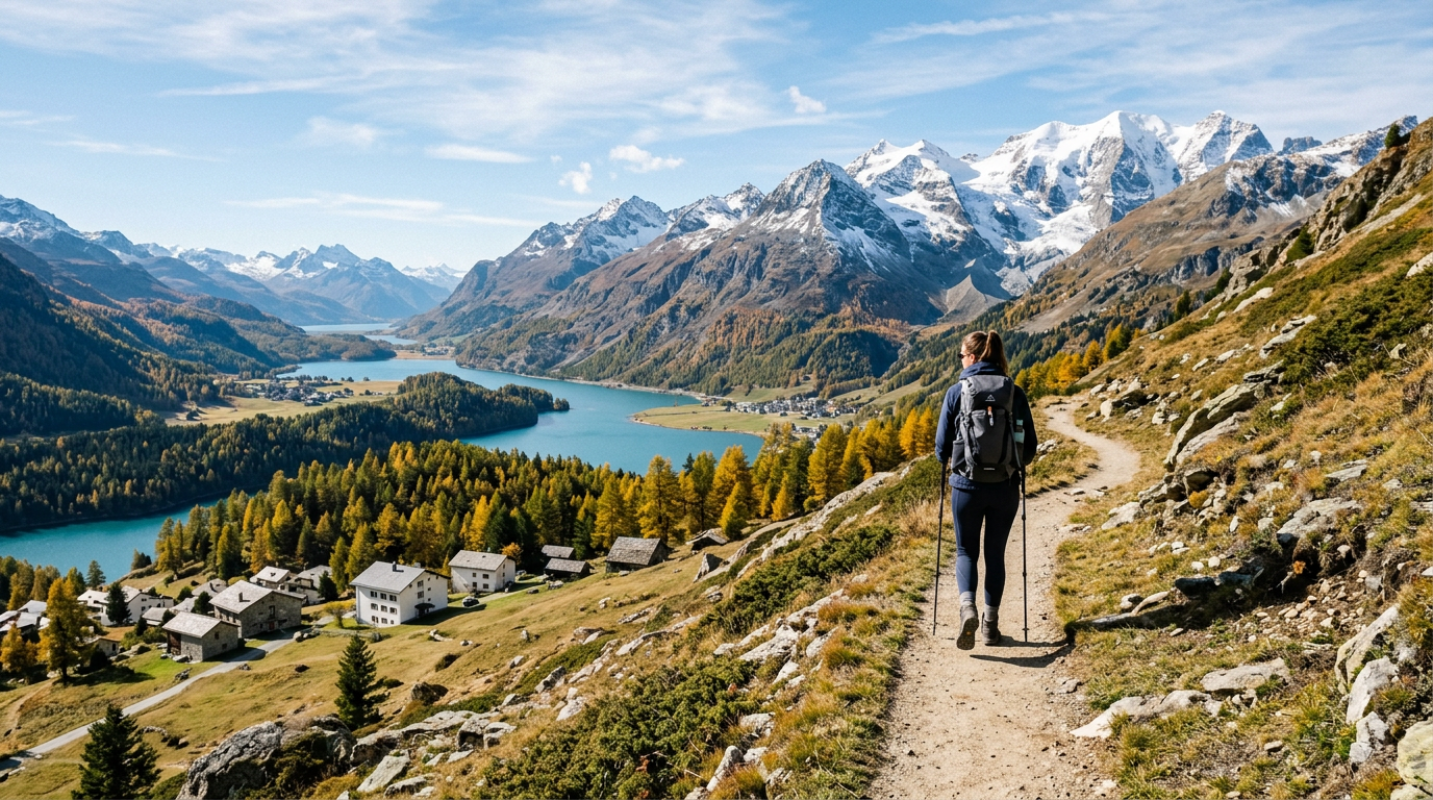
If you want the best views with the least amount of suffering, you need to head straight for Muottas Muragl. It’s widely considered to have the best view-to-effort ratio in the entire Alps. You take a vintage red funicular up to the summit, and suddenly, the entire Upper Engadin lake plateau is laid out at your feet. From here, the Panorama Trail to Alp Languard is the one everyone talks about, and for good reason.
The route is about 6.8 kilometers long and takes roughly two and a half hours. It’s flat or slightly downhill, which is a rare gift in the Swiss Alps. You’ll be walking along a high balcony with the Bernina Massif, including the ice-capped Piz Bernina, staring you right in the face. It’s the kind of scenery that makes you stop every five minutes to take a photo, which is why that two-hour estimate usually stretches into three.
For those who want something a bit more substantial, the trek from the Corvatsch middle station (Murtèl) over the Fuorcla Surlej is spectacular. It’s a five-hour commitment that drops you down into the Val Roseg. The highlight is the Fuorcla Surlej hut, where you can grab a coffee and look directly at the Biancograt, a razor-sharp ice ridge that is the dream of every mountaineer in the region. The descent into the car-free Val Roseg is long, but you’re surrounded by ancient forests and glacial streams the whole way down.
- Muottas Muragl Panorama Trail: A 6.8 km easy walk that offers the classic "postcard" view of the four lakes of the Upper Engadin.¹
- Steinbock (Ibex) Trail: Starting from the Alp Languard chairlift above Pontresina, this is your best bet for seeing wildlife. It’s home to one of the largest ibex colonies in Switzerland.
- Val Roseg: A perfect valley walk for those who want to avoid steep inclines. You can even take a horse-drawn carriage one way if your legs give out.
- Guarda to Ardez: A cultural walk in the Lower Engadin that takes you through villages famous for their sgraffito-decorated houses.
Lakeside Serenity and Walking the Upper Engadin
Not every day in the mountains needs to be a vertical challenge. Sometimes, you want to walk around a lake and think about lunch. The paths connecting St. Moritz, Silvaplana, and Sils are perfect for this. They’re flat, wide, and incredibly well-maintained. If you’re traveling with family or want a recovery day, these are the routes to choose.
Walking along Lake Sils is a particularly special experience. There’s a specific energy there that has attracted thinkers and artists for centuries. Friedrich Nietzsche spent his summers in Sils Maria, and you can still visit his house. The trail along the southern shore of the lake toward Isola is stunning, especially in the afternoon when the Maloja wind kicks up, and the windsurfers start darting across the water.
These lakeside paths also give you a chance to explore the villages. Each one has its own personality. St. Moritz is the flashy cousin, full of high-end boutiques and grand hotels.⁴ Sils Maria is the quiet, intellectual retreat. Silvaplana is the sporty hub. Walking between them allows you to see the transition from high fashion to high adventure at your own pace.
The Swiss National Park and Untamed Wilderness
If you want to see what Switzerland looked like before humans started building cable cars and luxury hotels, you have to go to the Swiss National Park. Located near Zernez, it’s the oldest national park in the Alps and arguably the most strictly protected. You can’t bring dogs, you can’t leave the marked paths, and you can’t even pick a flower.
The result of these strict rules is a level of biodiversity that is hard to find elsewhere. If you’re quiet and bring a good pair of binoculars, you’re almost guaranteed to see something. Val Trupchun is the place to go for wildlife spotting. It’s often called the Serengeti of the Alps. During the red deer rutting season in late September, the valley echoes with the sound of stags roaring. It’s a primal, slightly haunting experience that feels a world away from the manicured lawns of St. Moritz.
Hiking here feels different. The trails are a bit more rugged, and the sense of isolation is stronger. You’re a guest in a protected sanctuary. It’s a reminder that even in a country as developed as Switzerland, there are still places where the wild has the upper hand.
Expert Travel Tips for Your Engadin Adventure
So how do you actually make this happen? Timing is everything. Although summer is great, many locals will tell you that the first two weeks of October are the real peak season. This is when the larch trees turn a brilliant, fiery gold. The entire valley looks like it’s been set on fire, and the contrast against the blue lakes is almost too much to take in.
Logistics in the Engadin are surprisingly easy thanks to the "Mountain Railways Included" offer. If you stay at least two nights in a participating hotel or apartment, you get free use of up to 13 cable cars, funiculars, and chairlifts, plus free public transport. It’s one of the best deals in the Alps and removes any hesitation about hopping on a lift for a quick afternoon walk.
Regarding gear, don't let the sunshine fool you. You’re at high altitude, and the weather can flip in minutes. Even in July, you should have a solid waterproof shell and a warm layer in your pack. The sun is also incredibly strong at 2,500 meters, so a hat and high SPF sunscreen are non-negotiable.