 (Image source: Gemini)
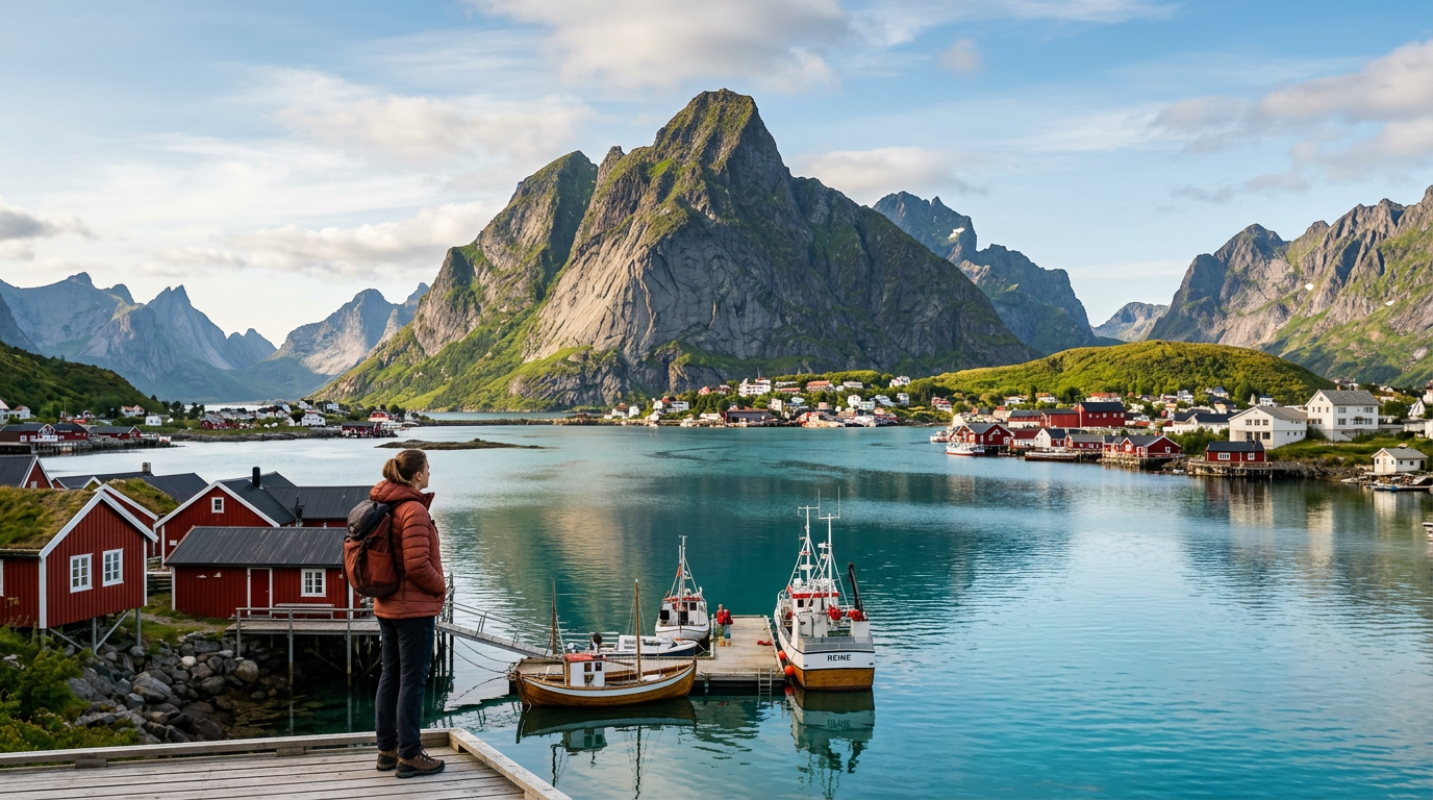
 You've probably seen the photos of Lofoten. Those jagged, shark-tooth mountains rising straight out of a turquoise sea look like something from a high-budget fantasy film. But if you visit in the middle of July, you might spend more time looking at the bumper of the campervan in front of you than at the scenery. That is why late August and early September are the secret windows for those who actually want to breathe.
By late August, the temperatures usually hover between 11°C and 14°C. It is perfect hiking weather. You won't be sweating through your base layers, but you also won't be freezing as long as you keep moving. By the time September rolls around, you might see the mercury dip toward 8°C, but the trade-off is worth it. You get the first hints of autumn color creeping into the moss and shrubs, turning the hillsides into a mix of rust and gold.
Why Late Summer is the Sweet Spot for Lofoten
Have you ever tried to find a parking spot at a popular trailhead in July? It is a nightmare. By late August, the domestic Norwegian tourists have mostly headed back to work and school. The crowds thin out significantly, giving you a chance to experience the silence that these islands are actually famous for. It is the difference between feeling like a tourist in a theme park and feeling like an explorer in the wild.
The lighting conditions during this period are a photographer's dream. Since the sun actually sets now (unlike in June), you get these incredibly long, drawn-out sunsets and sunrises. The sky spends hours in a state of pink and orange transition. This is the "Golden Transition," where you get enough daylight to fill a massive itinerary but enough darkness to finally see the stars again.
Must-Experience Spaces and Hikes
If you are going to Lofoten, you are there to climb. Late summer is arguably the best time for it because the trails are finally free of the stubborn winter snow that lingers into June and July. Paths like Reinebringen and Ryten are in their prime condition. You don't need crampons or heavy mountaineering gear, just a sturdy pair of boots and a bit of stamina.
Reinebringen is the big one. It has nearly 2,000 "Sherpa steps" built into the mountainside to help manage the erosion and make the climb safer. Is it steep? Absolutely. Your quads will be screaming by the time you reach the top. But when you look down at the village of Reine and the surrounding fjords, you'll realize why it is the most famous view in Norway. In late summer, you can often enjoy this view without having to elbow twenty other people for a spot on the ridge.
Authentic Coastal Living Rorbuer and Local Culture
Villages like Reine, Nusfjord, and Henningsvær are the cultural heart of the islands. Nusfjord is one of the oldest and best-preserved fishing villages in Norway, and walking through it feels like stepping back a century. Henningsvær, spread across several small islands, has a more contemporary vibe. It is home to art galleries, craft breweries, and a world-famous football pitch carved directly into the rock.
The food in late summer is a highlight. You are right at the source of some of the best seafood on the planet. Although the famous stockfish (dried cod) is a staple year-round, you'll also find fresh halibut, salmon, and Arctic char on the menus. Many local restaurants focus on what is in season, so you might find dishes paired with wild berries or mushrooms foraged from the nearby hills.
Needed Travel Logistics for a Seamless Trip
Getting around Lofoten requires a car. There is no way around it. Although there are buses, they are designed for locals and school kids, not for tourists trying to reach remote trailheads. If you want the freedom to stop whenever you see a dramatic rainbow (which will be often), you need your own wheels. Renting a car should be your first priority, ideally booked months in advance, as supply is limited.
The ferry system is your lifeline to the mainland. Most people take the ferry from Bodø to Moskenes. If you are bringing a car, you must book this in advance. For foot passengers, it is actually free, which is a rare bargain in Norway. Driving the E10, the main road that runs the length of the islands, is an experience in itself. It is a designated Norwegian Scenic Route, and every turn reveals a new mountain range or a hidden cove.
Packing for the Arctic coast is an exercise in layers. Think of your clothing as a system. You want a wool base layer, a fleece or light down mid-layer, and a high-quality rain jacket. Don't forget a hat and gloves, even in August. That wind coming off the North Atlantic doesn't care what the calendar says.
Chasing the First Signs of the Aurora
One of the biggest perks of visiting in late August or early September is the return of the Aurora Borealis. During the height of summer, the sky never gets dark enough to see the lights, even if they are dancing right above you. But as the nights lengthen, the window for the Northern Lights opens back up. The first sightings usually happen around August 20th or 25th.
The weeks around the Autumn Equinox in late September are statistically some of the best for aurora activity due to the way the Earth's magnetic field interacts with the solar wind. For the best view, head away from the village lights. Beaches like Uttakleiv or Skagsanden offer wide-open northern horizons with zero light pollution. There is something truly magical about spending the day hiking a mountain and the night watching the sky catch fire.
- Lofoten International Art Festival (LIAF): This is Scandinavia’s longest-running art biennial. If your trip falls in September, make sure to check out the exhibitions in Svolvær. It is a fantastic way to see how the space inspires contemporary artists.¹
- The Svolværgeita (The Goat): For the truly brave, this twin-pinnacle rock formation offers a famous leap between two stone horns. Even if you don't jump, watching the climbers from below is a great afternoon activity.
- Tørrfisk Tasting: Don't leave without trying the local stockfish. It is the backbone of Lofoten's history and economy. It is an acquired taste, but it is as authentic as it gets.