 (Image source: Gemini)
 You know that feeling when you finally turn off your GPS and let a city take the lead? In Lisbon, that's not a suggestion. It's practically a requirement. This city wasn't built for efficiency. It was built for discovery. If you're visiting in 2026, you're stepping into a city that has officially been crowned the happiest travel destination for 2025. Why? Lisbon has mastered the balance between a buzzing creative scene and a slow, sun-drenched lifestyle. It's a place where couples are looking for exactly what you're likely seeking: a bit of intimacy in a world that feels too fast.
The Art of Getting Lost in Alfama
Alfama is the soul of Lisbon. It's the oldest neighborhood in the city, and it feels like a physical manifestation of a memory. The streets here are narrow, winding, and completely indifferent to your sense of direction.
So what does this actually mean for you? It means you should start at the top and let gravity do the work. Don't look for a specific landmark. Instead, listen for the sound of Fado music drifting from a hidden tavern. That haunting, melancholic singing is the heartbeat of the district.
In Alfama, the slow pace of travel isn't a choice; it's the only way to move. You'll find yourself stepping aside to let an elderly neighbor pass with her groceries or pausing because a cat is napping on a sun-warmed stone step. These small moments are the real Lisbon. It's about the shared silence between you as you handle a staircase that seems to lead nowhere, only to find it opens up to a tiny square with a single lemon tree.
Miradouros Romantic Vistas at Every Turn
Lisbon is the city of seven hills. Although your calves might complain by day two, your eyes will be forever grateful. The miradouros, or viewpoints, are the city's public living rooms.
If you want the best view, head to Miradouro da Senhora do Monte. It's the highest point in the city. Although it's popular, it feels significantly more intimate than the crowded Santa Justa Lift.¹ There’s something about watching the sunset over those terracotta rooftops that makes the rest of the world feel very far away.
If you’re looking for a quiet corner, try Miradouro do Torel. It's often overlooked by the guidebook-clutching crowds. It’s surrounded by gardens and offers a peaceful spot for a private picnic. The trick to enjoying these spots is timing. Arrive about 30 minutes before the golden hour. Bring a bottle of local wine and sit. No phones, no plans, only the light turning the city into a gold-leaf painting.
Cobblestone Paths and Hidden Courtyards
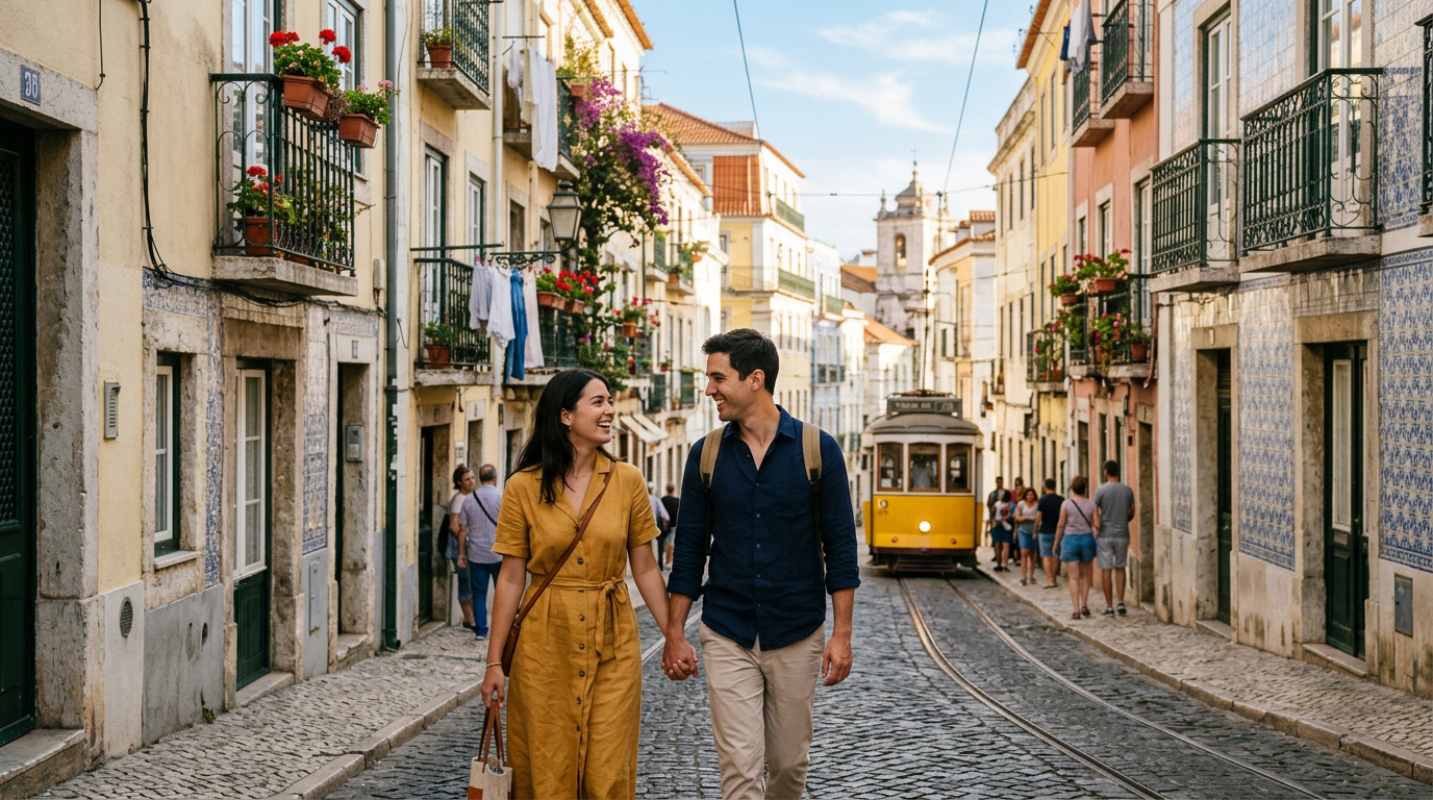
You can't talk about wandering Lisbon without mentioning the calçada portuguesa. These are the mosaic pavements made of small flat stones. They’re beautiful, but they’re also a reminder that walking is the only way to truly see the city's details.
For a route that feels like a private film set, head to Vila Berta in the Graça neighborhood. It’s a preserved early 20th-century street with Art Nouveau facades. It’s tucked away from the main tourist paths and feels like a secret you’ve been invited to keep.
If you want a different vibe, try the Madragoa district. Known as a secret pocket of color, this former fishing village has some of the most striking tile patterns in the city. Look for the Chafariz da Esperança, an 18th-century fountain that’s a perfect spot to rest your feet and people-watch.
The Industrial Edge of Marvila
Maybe you prefer something a bit more modern? Head east to Marvila. This is the industrial romance path. It’s where you’ll find converted warehouses, create breweries like Dois Corvos, and the Fábrica do Braço de Prata. It’s a bookish, artsy space with tucked-away reading rooms that are perfect for a quiet afternoon.
The Creative Loop in The Triangle
There’s a specific area locals call The Triangle. It connects Rua de São Bento, Rua do Poço dos Negros, and Rua Poiais de São Bento. This is arguably the coolest underrated hub in 2026. It’s flat, which is a rare gift in Lisbon, and filled with specialty coffee shops and artisan ateliers. It’s the perfect place to wander if you want to see how the creative class of Lisbon actually lives and works.
Cafe Culture and Shared Bites
Wandering is hungry work. In Lisbon, stopping for a Pastel de Nata is a ritual. You’ll find these custard tarts everywhere, but sharing one while it’s still warm from the oven is a mandatory experience.
The city's food scene has shifted toward "high-value" experiences. This doesn't mean expensive. It means authentic. Look for small, family-run tascas. These are the tiny eateries where the menu is often handwritten, and the wine comes in a ceramic jug.
If you want a real destination date, take the 15-minute ferry from Cais do Sodré to Cacilhas. Walk along the Cais do Ginjal, a crumbling waterfront path, to reach restaurants like Ponto Final. You’ll be sitting right on the edge of the river with the 25 de Abril Bridge stretching out in front of you. A heads up: booking 3 to 4 weeks in advance is needed these days.
- Best Hidden Street: Vila Berta in Graça, for its unique Art Nouveau architecture.
- Best Quiet Viewpoint: Miradouro do Torel, for a garden-like atmosphere away from crowds.
- Best Creative Hub: The Triangle (Santos/Estrela) for natural wine and artisan coffee.
- Best Sunset Walk: Cais do Ginjal in Cacilhas for riverside views of the city skyline.
- Best Local Ritual: A morning bica (espresso) and pastel de nata in a neighborhood praça.
Practical Tips for an Effortless Lisbon Stroll
Before you set out, let's talk logistics. Lisbon is beautiful, but it can be challenging if you aren't prepared.
First, the shoes. Leave the heels at home. The cobblestones are slippery, especially when they’ve been polished by millions of footsteps or a light rain. Wear sneakers with a good grip. You’ll thank me when you’re navigating a 30-degree incline in Bairro Alto.
Second, think about the timing. Lisbon welcomed 8.52 million visitors in 2024, and that number has stayed strong. To avoid the squeeze, start your walks early or late. The light at 8:00 AM is incredible for photos, and the streets are yours.
Finally, embrace the topography. The hills are what give the city its character. If you get tired, hop on one of the iconic yellow trams, but remember they are often packed. Sometimes the best way to get around is the simplest: keep walking, hand in hand, and see where the next alleyway leads.