 (Image source: Gemini)
 Have you ever felt like you were standing on the edge of the universe? It sounds like a line from a cheesy sci-fi movie, but at the Salar de Uyuni, it is another Tuesday morning. This place is the world's largest salt flat, covering over 10,000 square kilometers of the high Bolivian Altiplano.
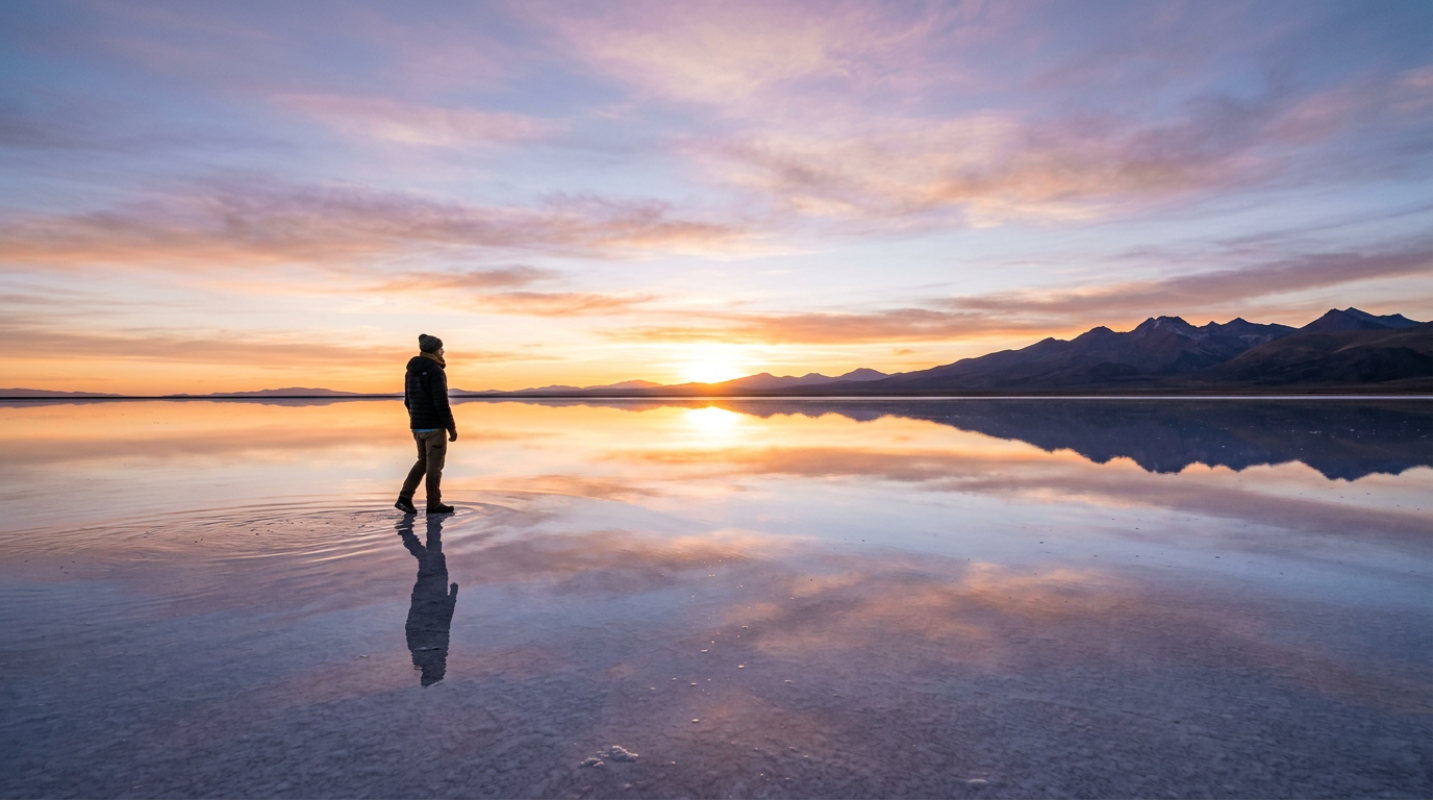
When you arrive in the pre-dawn darkness, the ground feels like crunchy snow under your boots. But as the light starts to bleed over the horizon, everything changes. The white salt crust begins to glow, and if you are there during the wet season, the thin layer of water turns the entire earth into a giant, perfect mirror. It is a top-tier bucket list destination for a reason. You aren't looking at a pretty view. You are standing in a space where the sky and the ground have decided to become the same thing. It is disorienting, beautiful, and a little bit addictive.
Why Sunrise is the Only Time That Matters
You might be tempted to sleep in and visit the flats when the sun is high and warm. Don't do it. The midday sun is a harsh critic that flattens the terrain and turns the white salt into a blinding glare that will have you squinting in every single photo.
Sunrise is when the physics of light do something truly weird. During the "blue hour," about 45 minutes before the sun actually breaks the horizon, the atmosphere acts like a giant softbox. You get these deep purples and electric blues that reflect off the salt, creating a sense of infinite space.
Beating the crowds is another huge plus. Most of the day-trippers arrive much later, so the early hours give you a sense of solitude that is hard to find at other major world wonders. Plus, the air is still in the morning, which is exactly what you need for those perfect, glass-like reflections.
Planning Your Expedition
Your experience depends entirely on when you go. If you want that famous mirror effect, you need to visit during the wet season, which runs from December to April. The peak months are January to March, when a few centimeters of water cover the salt and erase the horizon line.
If you prefer the dry season, from May to November, the water evaporates to reveal strange, hexagonal salt patterns. This is the best time for those famous perspective-play photos where people look like they are standing on top of giant Pringles cans. It is also much easier to drive across the flats to spots like Incahuasi Island during these months.
What to Expect When the Sun Breaks
The transition from total darkness to first light is surprisingly fast. One minute you are shivering in a pitch-black void, and the next, the world is a wash of neon orange and soft pink. It is a sensory shift that catches you off guard every time.
When the sun finally cracks the horizon, the light hits the salt crystals and creates a sparkle that looks like millions of tiny diamonds. This is the moment to grab your camera. If you are there for the reflections, get your lens as low to the ground as possible to get the most from the symmetry between the sky and the water.
For those perspective shots in the dry season, you need a high f-stop setting, usually between f/8 and f/11. This keeps both your foreground prop and your friend in the background in sharp focus. It sounds simple, but getting the alignment right takes a bit of trial and error (and a lot of laughing at your friends).
Sustainable Tourism and Preserving the Flats
We have to talk about keeping this place pristine. The Altiplano is a fragile environment, and with thousands of visitors every year, the pressure on the ecosystem is real. Responsible travel here is a requirement if we want these flats to stay white.
One of the coolest things happening right now is the Eco Tomodachi initiative. They have been working to cut down on the thousands of plastic bottles that used to end up in the trash here by distributing reusable tumblers to tourists. It is a small change that makes a massive difference in such a remote area.
The Morning You Will Never Forget
By the time the sun is fully up and the air starts to lose its bite, you will realize that you haven't stopped smiling for two hours. There is something about the scale of the Salar that resets your brain. It makes your daily stresses feel as small as a single grain of salt.
Is it a long journey? Yes. Is it cold at 4:00 AM? Absolutely. But when you see that first ray of light hit the mirror-flat water, all of that disappears. You are left with a memory that is far more vivid than any photo could ever capture.